How do I determine my horse's weight?
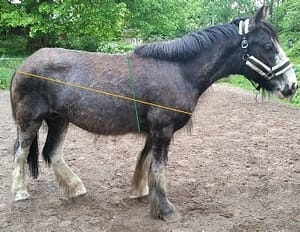
The easiest way, of course, is to put your horse on a horse scale. Book an appointment to come to your location to weigh your horse hereAnother way to calculate your horse's weight is through the formula below. Note: it is a global determination!!!
(Chest girth in cm)² x (Length in cm) / 11,880 = Weight of the horse in kg
Opportunities to have manure tested
- You bring the manure along.
- You order a manure kit and send it to me.
- You provide it during a weighing moment of your horse by us.
Types of worms in horses.
For a detailed description of worms and their life cycle, I refer to:
www.parasietenwijzer.nl
The following is a brief description of the most common worms in horses.
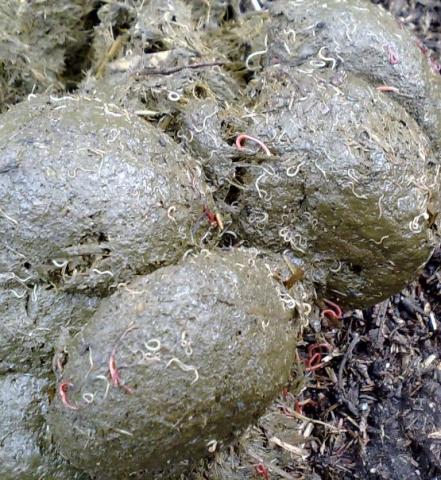
Large strongylids (Strongylus vulgaris)
These worms make a trek through the body. After the larvae enter, they crawl through the intestinal wall and enter the blood vessels. This can cause the blood vessel wall to inflame and thicken, making blood flow more difficult. As a result, the horse may exhibit colic symptoms.
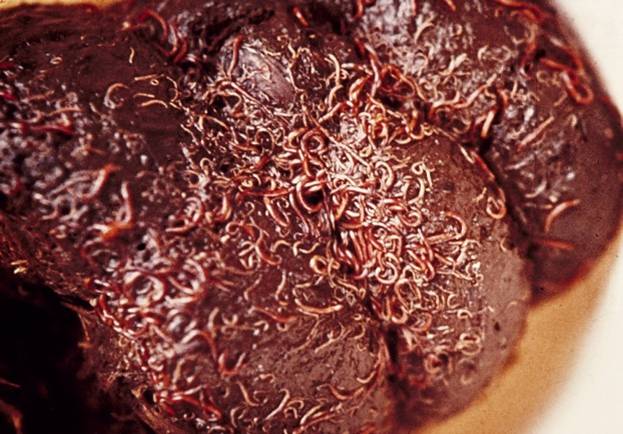 Small or red bloodworm (kleine strongyliden, Cyathostominae)
The larvae of this worm cause the most problems in adult horses. This is due to the hatching of small bloodworm larvae that have sometimes encapsulated themselves in the intestinal wall for several years. Generally, this occurs in young horses in late winter or early spring. In addition to the damage to the intestinal wall, there is also the danger of secondary infections from bacteria that then have free rein.
Symptoms may include emaciation, barren coat, lethargy, diarrhea and dehydration.
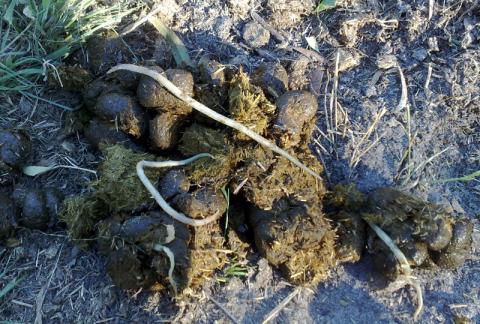 Foalworm (Strongyloides westeri)
The foal worm is given to the foal by the mother in the milk. It is only a threat in foals up to 6 months old. Symptoms are generally mild diarrhea. If severely infected, it can cause emaciation, sometimes fever and even death. So if a foal has diarrhea, have a fecal examination.
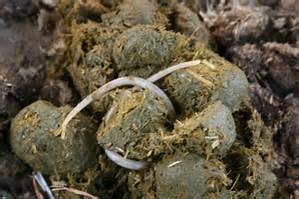 Roundworm (Parascaris equorum)
This is the most dangerous worm for foals. It can grow as long as 40cm and if the infection is severe enough, intestinal blockage can occur (right even after worming, the worms die) and the intestine can even rupture. The roundworm develops from egg to adult worm in about 70 days. So the advice is therefore to worm the foal at 60 days with a suitable drug for foals and roundworms. Upon finding 1 egg of the roundworm, a foal is often already dewormed. It is therefore wise to examine the manure fortnightly.
Symptoms may include lethargy, poor eating, emaciation but sometimes coughing or sniveling. And in case of a major infection, of course, colic symptoms.
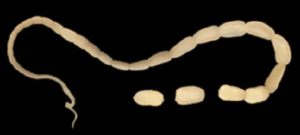
Tapeworm (Anoplocephala perfoliata)
This worm is not often the cause of disease in horses. The only symptoms we sometimes see are constipation colic or invagination (entrapment of the small intestine).

Determining an infection is also difficult because the eggs are excreted intermittently and also you almost never find the proglottids (particles of the worm, look like rice) in the manure. You also rarely find a tapeworm egg in the manure test. So it is therefore once a year deworming with a broad anthelmintic (which therefore also tackles the tapeworm) is recommended.